"The universe is just there; that’s all.
And there is no 'why' or 'what for.'
The very idea of purpose is a form of entropy."
- Frank Herbert
Entropy is an ongoing series of aleatoric compositions in which cosmic ray detectors determine the outcomes of live performance.
Cosmic rays are high-energy particles that rain down on Earth constantly, having travelled millions of light years from exploding stars and distant galaxies.
They are among the most randomly distributed phenomena in the known universe. Their arrival times, energies, and directions are fundamentally beyond prediction. Entropy embraces this randomness as a compositional force.
The detectors are not instruments of measurement; they are conductors in a performance.
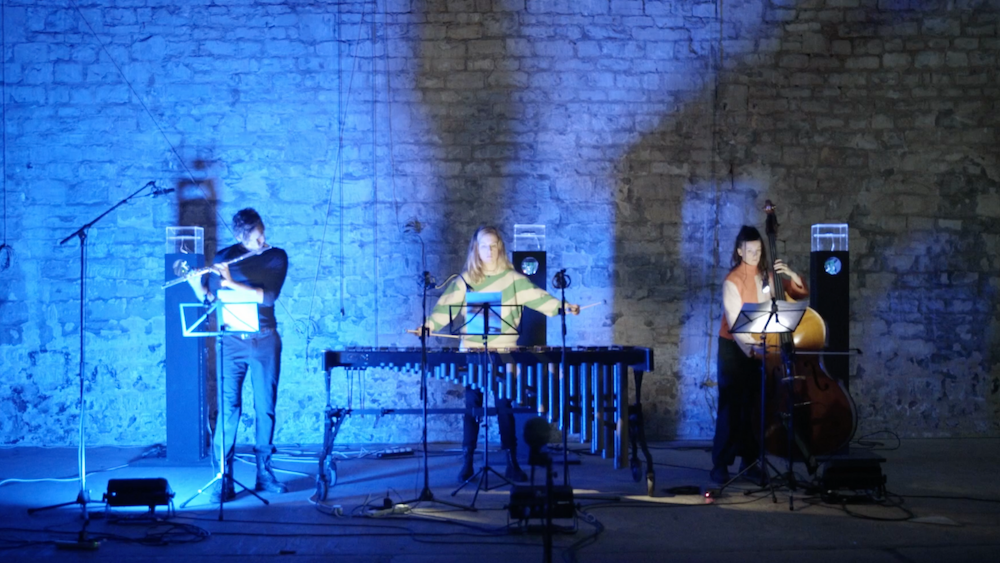
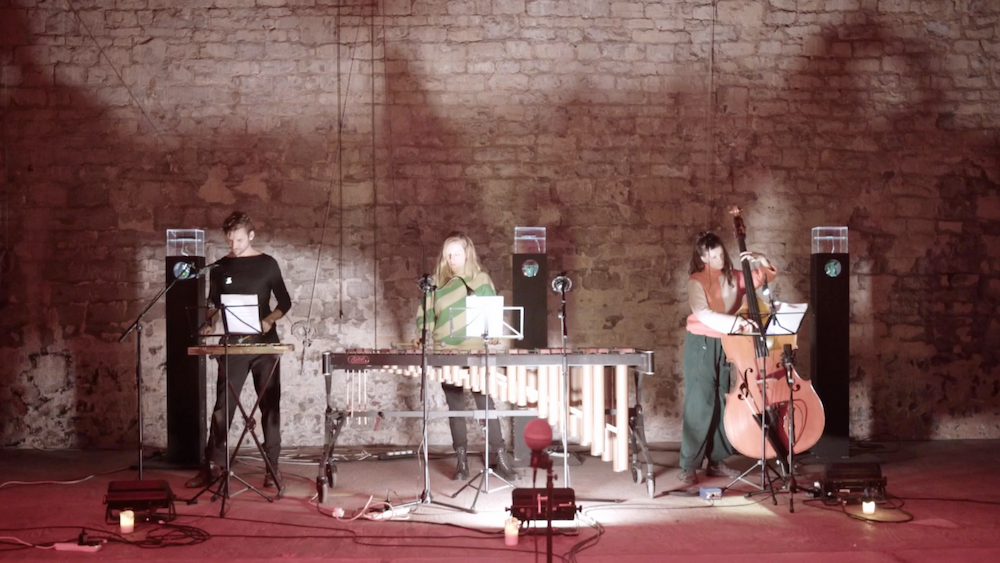
In each piece in the series, musicians are linked to bespoke cosmic ray detectors.
Each time a muon passes through a detector, it releases photons; these are converted to a flash of light whose colour, brightness, and duration encode the particle’s energy and influence the performance.
The particles determine when musicians may play and at what intensity, but within those constraints, the performers bring their full musicianship: responding to each other, soloing, and shaping the texture with their own voices.
Every performance is different, shaped by live muon detections in the space
Works in the series so far:
Each work in the series uses a different mechanism for progressing through the score, all governed by cosmic ray detections or the performers' responses to them.
Entropy II — players progress through each section in the score when one designated player decides. Some sections contain solos.
For marimba, tenor saxophone and double bass
Entropy III — players perform in front of a timer and progress through each section in the score when an allotted time is reached.
For marimba, flute and double bass
Entropy IV — players progress through each section in the score when an allotted amount of muon detections has been reached i.e. move to next bar after 4 detections. Some sections contain solos.
For marimba, glockenspiel and double bass
| Release Date | Specifications | Commissioner |
| 2023 | Cosmic Ray Detectors ( Arduino, RF Transmitter, Scintillator, PCB), Code, LEDs, Wood, Acrylic | Hidden Notes Festival / SVA |
Core Concept
- Each time a cosmic ray passes through a detector, it triggers a light.
- The colour and brightness represents the energy of that particle.
- Each musician is ‘linked’ to a light/detector
- They must respond every time a cosmic ray is discovered.
- Each performance is different; dictated by various compositional methods
as well as the intensity of cosmic rays in that precise location, at that moment.
Rules For performers
This varies slightly for each composition varies slightly, but in general:
Every time the detector is triggered, you must respond to each reading immediately
by playing your chosen/given phrase as close as possible to the moment the flash of light begins.
If an additional reading interrupts your phrase, you must abandon the current phrase and begin a new phrase as soon as possible.
You may repeat the phrase you were playing or select a new one.
The phrases may intertwine.
You may always choose the octave that you play in.
The length of pieces are either dictated by a fixed time frame or by the amount of readings
For fixed time frame pieces, you must play the phrases as many times as dictated by the detector during that time slot.
Once the time runs out, move on to the next selection of phrases / time frame.
If a phrase is still being played when the time of that section runs out,
complete that phrase before moving on to the new selection of phrases.
Some pieces you will be given 3 phrases to choose from.
You may select any phrase and can repeat phrases as many times as desired.
In some pieces, the dynamics of your phrase will be controlled by the colour, intensity and duration of the light:
Short blue flash = p (quiet)
Medium length blue flash = mp (moderately soft)
Pink to blue flash = mf (moderately loud)
Long pink flash = ff (very loud)
Be aware of other players' performances.
Let their musical choices and density of their readings influence your own decisions.
Credits
Composition & concept by Christo Squier
Recorded live at Brunel Goods Shed, Stroud, UK 4.10.2023
Solos by the respective musicians:
Catherine Ring - Marimba
Christo Squier - Tenor saxophone, Flute, Glockenspiel
Stevie Toddler - Double bass
Motz Workman - Filming & editing
Bill Brooks - Recording & mixing
Chris Ball - Creative technologist
Dr. Teppei Katori - Scientific advisor
With thanks: The Faculty of Natural Mathematical & Engineering Sciences, CosmicWatch, SVA, Hidden Notes, d&b Audiotechnik and King's College London