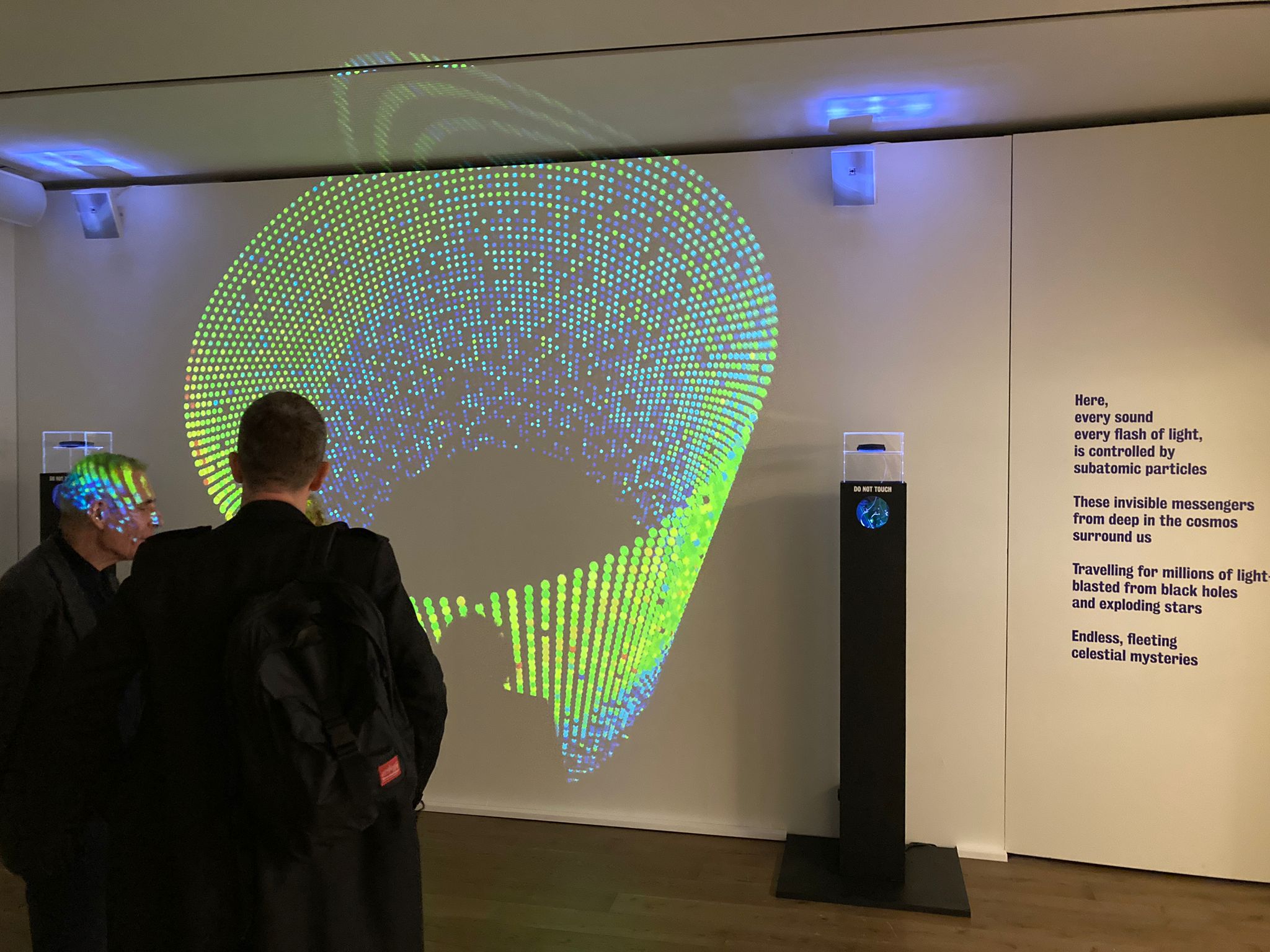
"Invisible messengers,
From deep in the cosmos, surround us"
Sanctum is a generative sound and light installation in which every sonic and visual event is determined entirely by subatomic particles.
A gallery reconfiguration of the large-scale installation Particle Shrine, it was commissioned by King's College London for the Seeking Connections exhibition at Bush House from Spet 23 - Feb 24.
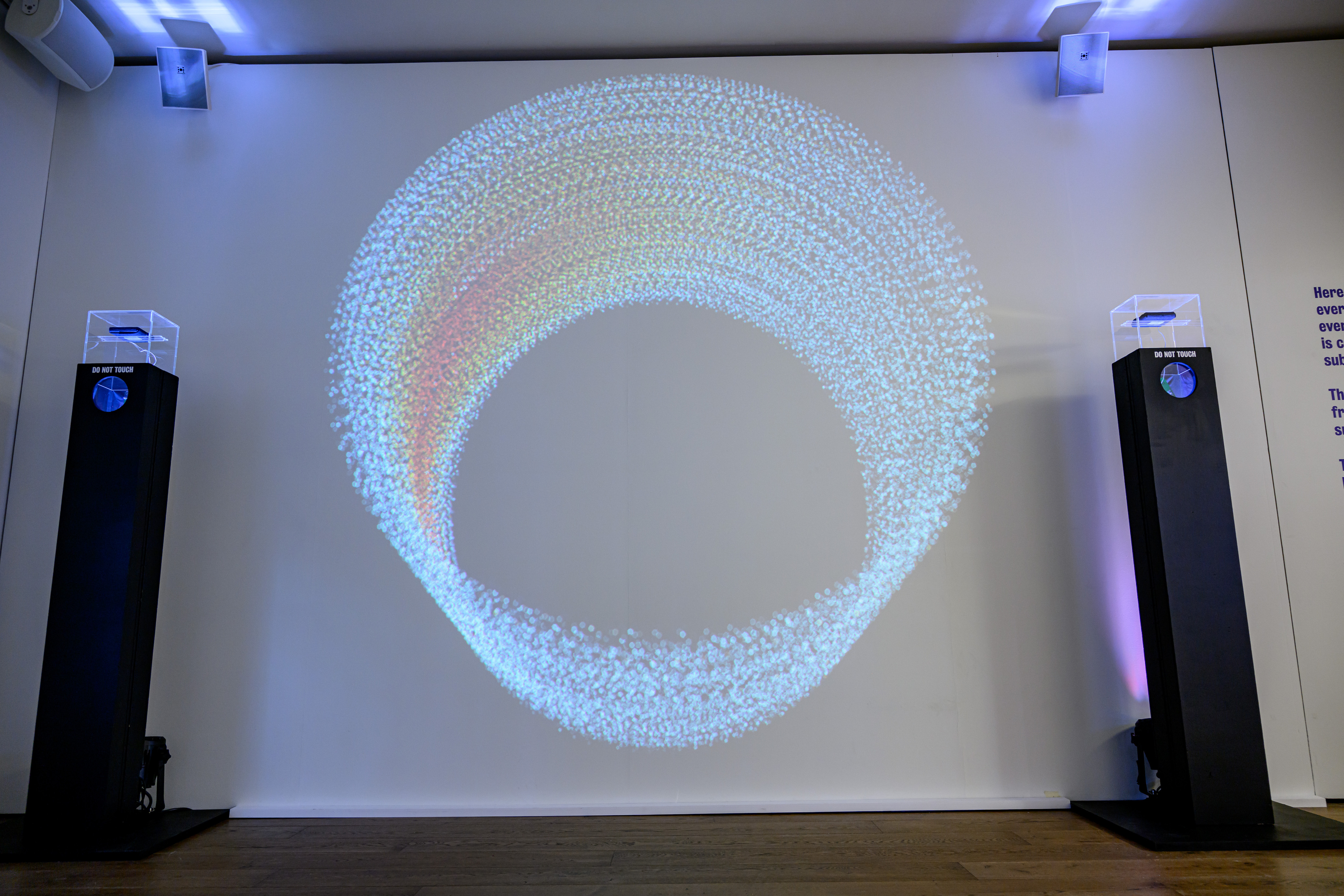
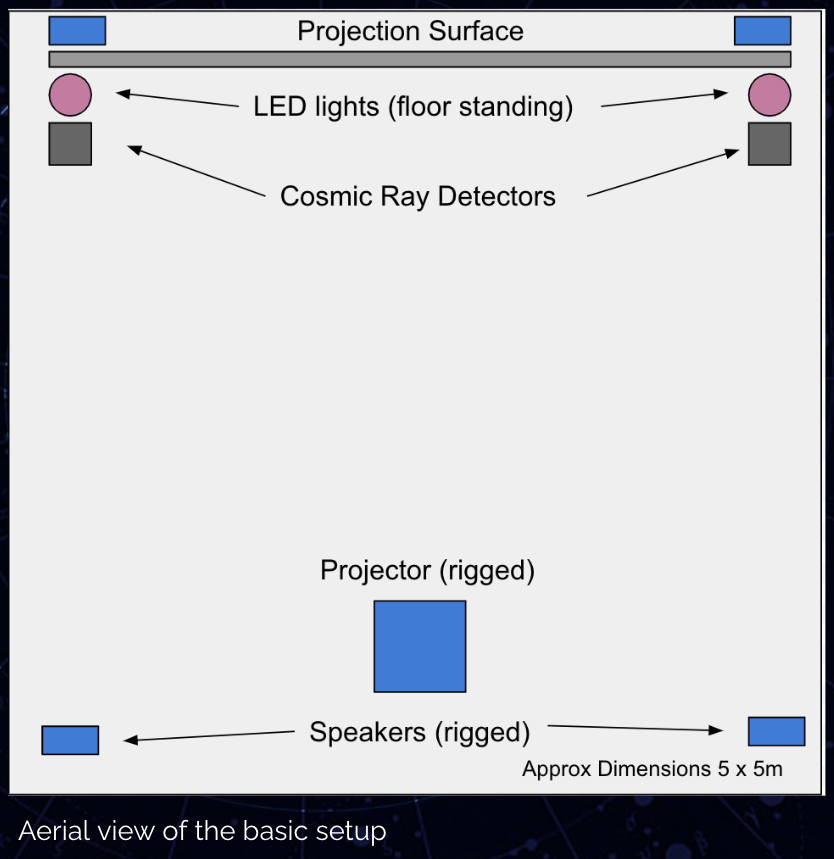
Audiences find themselves centred within a quadraphonic speaker array, two bespoke cosmic ray detectors flanking them on either side of a large projection surface. The effect is one of enclosure. Not entrapment, but shelter.
The intention is to provoke awe and wonder while offering something rarer: a felt sense of safety within a vast and beguiling universe. The particles passing through the room have travelled millions of light years from exploding stars and black holes; the piece aims to make that fact seem intimate, framing the cosmos as something we belong to rather than something that dwarfs us.
The piece draws simultaneously on two scales of live particle data.
Local detectors catch muons in real time as they pass through the room; each detection triggers sound and light proportional to the particle's energy.
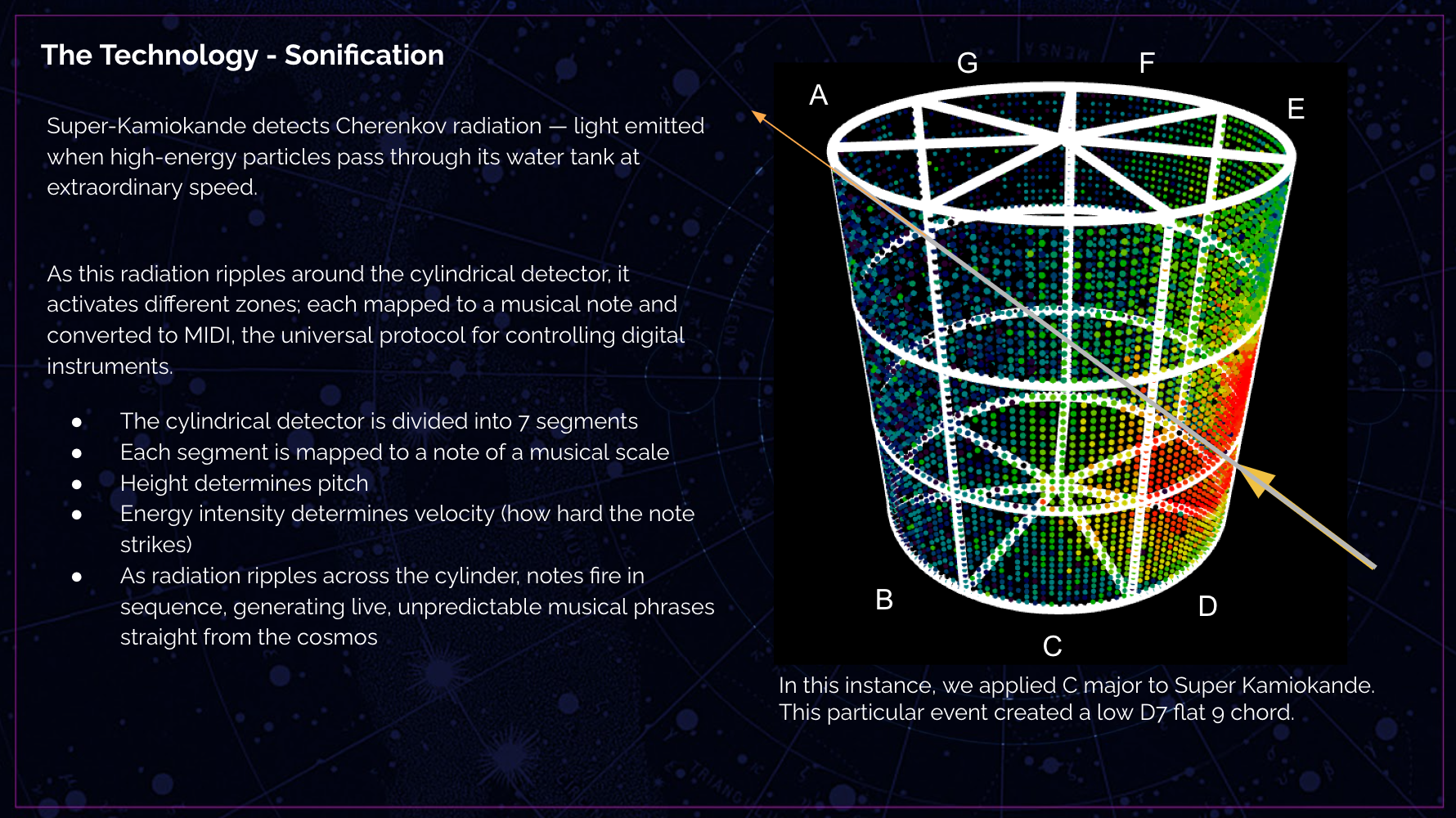
A continuous data feed from Super-Kamiokande (a Nobel Prize-winning neutrino observatory buried inside a mountain in Japan) drives expansive generative soundscapes and projected visuals.
The observatory's cylindrical detector is divided into seven spatial segments, each mapped to a note of a musical scale; the height of Cherenkov radiation events determines pitch, their density determines which notes are triggered, and their power determines velocity.
The geometry and physics of deep-earth particle detection become live, unpredictable composition.
Sanctum is rooted in the aesthetics of pure chance.
Cosmic rays are the most randomly distributed phenomenon in the known universe; their arrival times, energies and directions are beyond any predictive model.
Rather than imposing compositional structure onto this data, the piece yields to it entirely, extending the aleatoric tradition of Cage's chance operations, but grounded in actual physical randomness rather than dice or the I Ching.
Stochastic particle events become the score; the detectors are the performers.
The result is a generative system that is neither algorithmic in the conventional sense but dictated by physics itself, moment to moment, without repetition or resolution. Where Burke and Kant located the sublime in the terror of overwhelming scale, Sanctum asks whether that scale can instead feel like home.
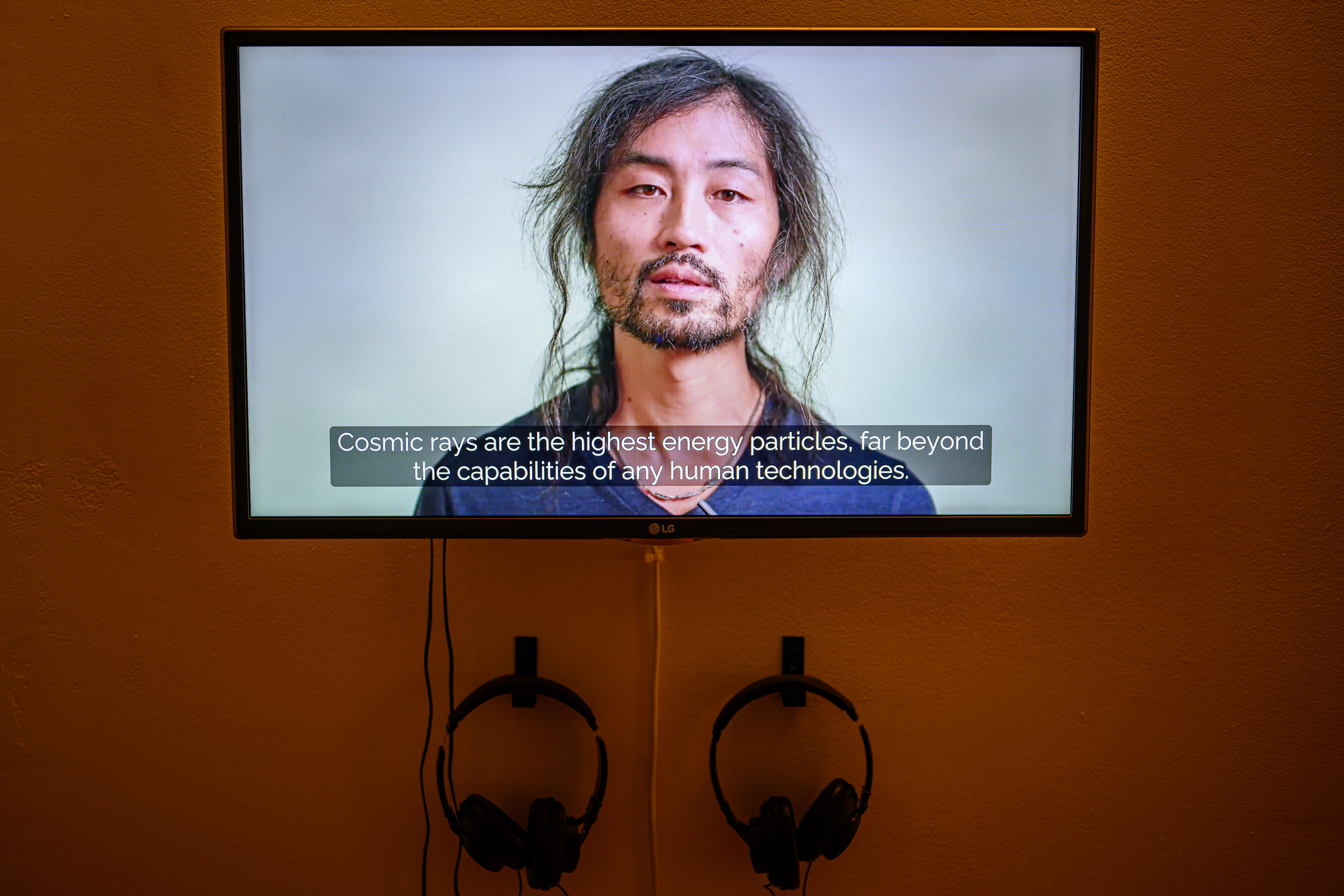
An optional companion video (nine minutes, shown separately) offers audiences a route into the physics and technology underpinning the work.
| Release | Specifications | Commisioner |
| 2023 | 2 Cosmic Ray Detectors (arduino, scintllator, RF transmitter, PCB) Code, Projector, Quadrophonic Speaker System, Wood, Acrylic, Optional 9 minute explainer video | King's College London |
CREDITS
Creative direction, composition, creative production, lighting design, poetry - Christo Squier
Creative technologist - Chris Ball
Producer - Jocelyn Cheek
Production support from Alphabetical Studio
Commissioned by King's College London
With thanks to Ableton and The Faculty of Natural, Mathematical & Engineering Sciences, KCL London.